
BR Workshops Class 03: D2128 - the refurbishment
Comparison details of D2128 |
||
| As built | As refurbished | |
| Engine | Gardner 8L3, rating 204bhp at 1200rpm | Cummins NT855, rating approx 350bhp at 1800rpm |
| Transmission | Vulcan Sinclair fluid coupling driving a CA5 change speed gearbox and RF11 final drive | Twin Disc 11535 converter and 20-2800 powershift driving the RF11 final drive |
| Weight | 30tons | 30tons approx |
| Train braking | Vacuum | Vacuum |
| Loco brake | Straight air and hand operation of tread brake linkage | Straight air and hand operation of disc on input to gearbox |
| Wheel arrangement | 0-6-0DM | 0-6-0DH |
| Location | ||
Work, began, largely outside, during 2010-11 with the installation of engine mounts and the preparation of detailed designs for the component layout. Indeed, during one winter we worked on occasion in a "tent" made from a tarpaulin over the casing frames while standing on ice in the track underneath us!
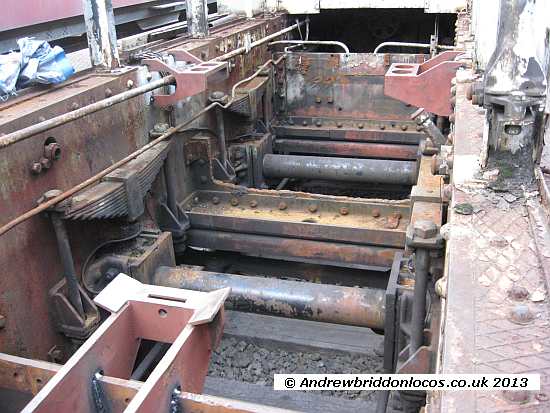
April 2011 and the front and side engine mounts are in place. At this point the handbrake shaft still ran up the side of the loco, this was subsequently removed and the mounting bracket made solid.
The engine was not finally installed until early September 2011, having been kept waiting several months to make use of an on-site crane - in the end Andrew brought a mobile crane up from Derbyshire, resulting in the engine and transmission being installed in one day.

From the front end of the engine we needed to drive 4 things - an air compressor (mounted front left) a radiator, an exhauster (which was located on the right hand side, rear of the engine but to use a propshaft drive along the side) and two charge pumps, one for the converter and one for the powershift. To do this an extension PTO shaft was fitted, with a torsional coupling from the front of the Cummins.
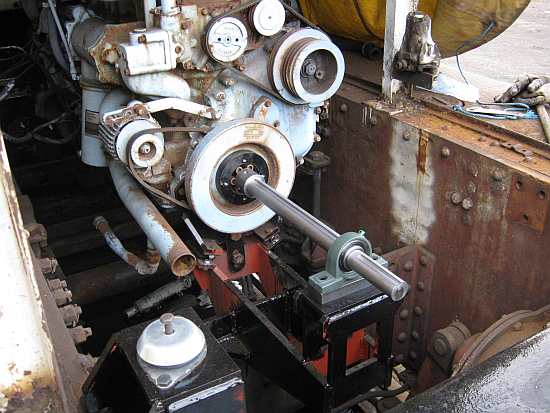
Work progressed through the winter of 2011-12, and we were hopeful of having the loco running in time for the AFRPS gala scheduled for May 2012. We prioritised a few things - the exhauster drive was left for later as was the disc brake, and casing mods to cover the exhauster and compressor postponed - but although the engine was running and the loco appeared in public on the Saturday, the transmission refused to drive. A month later, by tinkering with the pressure regulator, we achieved motion but only for 30-60 seconds at a time.
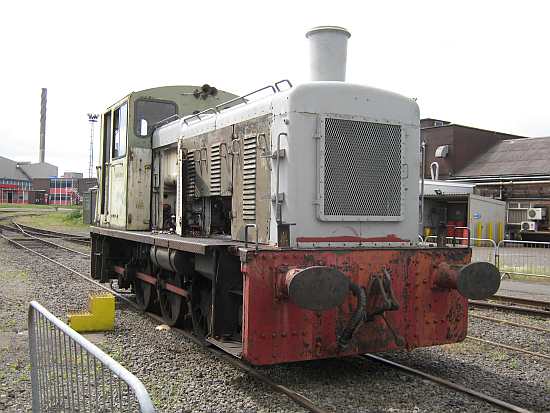
After messing around and taking advice, we bit the bullet and had the second transmission overhauled and swapped the two in November, 2012. The picture below shows the refurbished transmission being craned down into the loco.
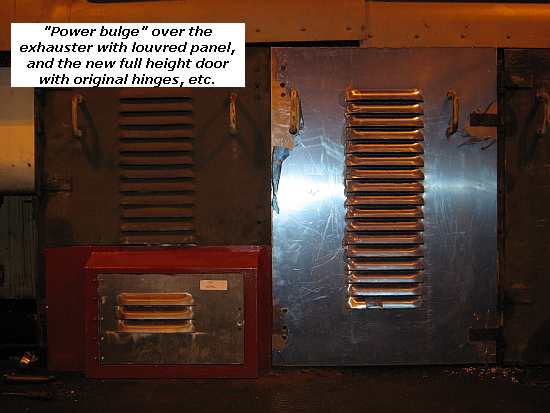
Annoyingly, all the expense and work made no difference, we could still not get drive! So for the moment we concentrated on Andrew's other loco at Scunthorpe, doing only odd bits on D2128 while we got up the courage to tackle it again. For example, the two casing bulges (compressor and exhauster) were manufactured, together with new new casing doors, all using louvre tooling kindly loaned by Gary Hibbs.

In the interim we had also been investigating where the problem might lie. The transmission overhauler offered to come in and go over the installation with us, but after several transatlantic phone conversations with Twin Disc, one issue that emerged is that the powershift charge pump, which is the same size as that originally fitted, and thought to be running at the same speed, may in fact deliver insufficient oil for reliable clutch operation. The two charge pump pulleys are located at the front of the PTO shaft, so changing the driving pulley and fitting new belts was a relatively easy task. Having done so, D2128 started and drove, although indicated pressure was low and the drive slow to engage. You can see it in operation on the video section of Weekend Rails by going to the weblinks section of this site. The disc parking brake was commissioned, operated from the original handbrake wheel. The cab roof removable section was replaced, and work continued on the exhauster drive: attention to the rusted cab sides is planned for 2014. On December 7th the locomotive was axle weighed at the rail weighbridge: the lighter power unit was bound to have affected the loco's balance and some ballast will be added to the front end of the loco to compensate.
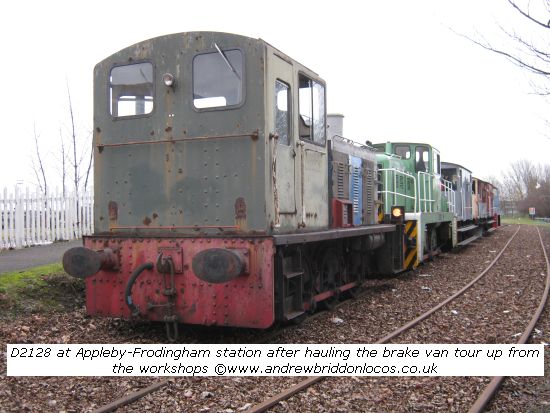
Adjustments to the transmission pressure regulator during December 2013 and January 2014 had the desired affect and on the 8th February, an enthusiast brake van tour on its way back to the Appleby Frodingham platform stopped outside the sheds, D2128 dropped on the front and hauled the train up the 1 in 50 gradient, before powering the now empty train back to the depot. The full story can be found on the Weekend rails blog, entitled "Of firsts and Seconds".
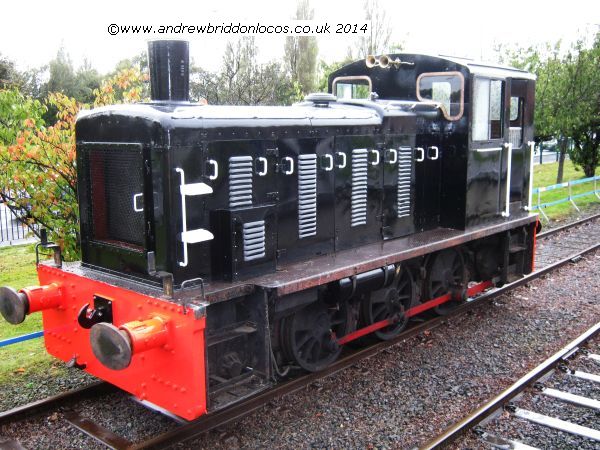
During the autumn of 2014 a concerted effort was made to get the locomotive more presentable. Aided by a small team of AFRPS members, the loco was cleaned down and cab/casings repainted in black with white handrails. A cab floor was fitted, and the locomotive performed satisfactorily during the gala weekend of 4th-5th October, although the water pump bearing on the Cummins engine had begun to fail and screeched loudly as soon as the throttle was increased above idle. Here it is just before its train arrived on the Saturday, marked for its wet conditions:
Work on the lights, vacuum brake system, etc remain to be progressed.
Archived News