
Latest developments - Spring 2012
As usual, much time and effort has been committed - and many miles incurred - as work continues on various locos in the collection. Much of the time this spring has concentrated at Scunthorpe, where locos "Beverley" and D2128 have been progressing.
D2128

Following the re-installation of the superstructure at the beginning of February, and although still parked outside the AFRPS shed with only a tarpaulin for protection, progress has been rapid. Amongst the parts added are the mounting for the exhauster -
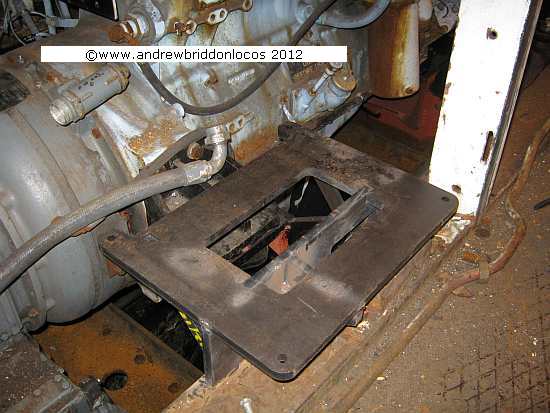
-which locates alongside the rear right engine mounts (the base was specifically drawn to allow the engine mounts to lift clear should it required) and will have a fabricated "power bulge" using one of the casing doors shortened in Belgium to allow air flow in for the Deutz engine. The exhauster itself has been mounted (below) and will in due course take its drive from a short propshaft alongside the engine, however this is not expected to be in place until the summer, although it is expected to have the vac brake working by May provided another loco is available for the "suck".

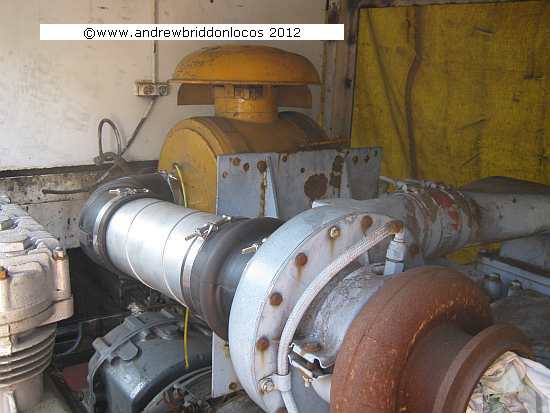
Subsequently the air inlet ducting between the air cleaner and the turbo was added (below) - the 'mushroom' pre-cleaner currently on the air cleaner will in due course disappear, with a flexible ducting bringing fresh air from a slightly more discrete mushroom mounted in top of the casings, utilising another aperture cut there while the loco was in Belgium.
At the front of the loco the radiator fan drive is well under way and was trialled in place in early March (below). The fan was subsequently ordered and final assembly is envisaged shortly. The compressor cylinder head is off for attention, after which it will be plumbed back into the air system.

Of the two visible un-belted pulleys, the rad fan will drive from the right one, leaving the last free for the later exhauster drive. Another pulley has subsequently been added that will drive the charge pumps, located out of sight below the drive shaft. The first of the coolant pipes is in manufacture - it drops down from the visible nearside lower aperture on the radiator in order to pass under the powershift cooler.
Up to now there has been little visible progress in the cab, although the disc brake which locates under the cab floor has at last been machined and will be assembled once the prop-shaft arrives. Above floor level however, the instrument and control panels have been assembled, together with dual control stations for the horns and "train charge" buttons and the driver's vacum brake valve. Behind the electrical panel the relays, fuses, etc have all been pre-wired, requiring only to hook up to various parts of the loco.

Beverley
Following the successful re-plumbing of the torque converter and subsequent start up, time has been spent investigating why the engine continues to "hunt", despite the fuel pump having been back twice and proven to be OK on the test rig at Cummins. Not knowing of course, whether this was a characteristic present prior to our acquisition - remember that the loco was apparently operable at the Shropshire collection but left parked up so long that rainwater got into the middle cylinders, resulting in seizure - means that we are as yet uncertain whether it is a problem we have created in re-jigging the pipework, or a sign that the injectors need going over. Andrew is confident of getting to the bottom of it shortly.
The new hydarulic oil tank unfortunately developed a slight leak and had to come back off for re-welding of a fitting, it is now back on the loco and some of the outstanding cosmetic tasks resumed. The handrails, removed 4 years or so ago, sheared several fixing bolts and these have been drilled out and re-tapped, enabling first the rear handrail -

- to be refitted, followed by the front ones. The casing doors have also been replaced as added protection after the AFRPS unexpectedly parked the loco outside as the track space was needed for carriage roof repairs. The grilles that form the centre sections of each door are currently away for shotblasting and priming, and will shortly be refitted.
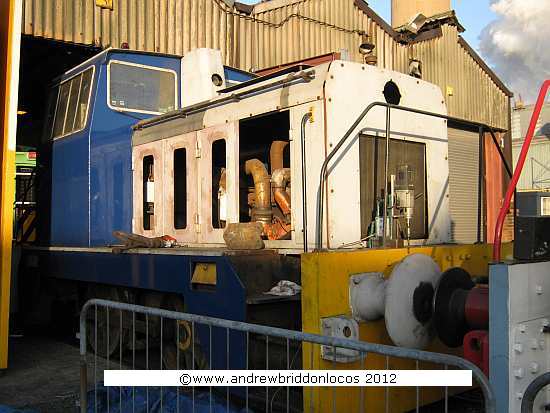
The exhaust cowl can also be seen back on the loco - but not yet bolted down - having had corroded patches cut out and replaced commercially. Other than the engine issues, attention is to be given to filling the gap created at the font where the casings have been extended 20mm to accomodate the new transmission cooler, and refitting the rad grille and headlamp, after which it is hoped to give the loco a once-only test run around the steelworks complex.
Pluto
A new set of vanes for the d.m.u. exhauster fitted on "Pluto" was bought and fitted but proved to be a disappointment, performing more poorly than the old ones they were meant to replace. The oil leak at the entrance to the oil separator has been sleeved and hopefully cured. The old vanes were refitted and the loco is in occasional use shunting at Murton and has yet to perform in passenger traffic, but the DVLR season starts on March 31st...
Libby
The casing tops have been removed for shotblasting/priming, and the converter oil reservoir has been removed and is to be re-located in front of the fuel tank - modified mountings have been prepared. The last vestiges of the corroded cab cupboard have gone. A 'new' transmission cooler (as in secondhand ex a loco scrapped from Poole Harbour) is being prepared for installation, after which the converter oil lines must be re-arranged. A new suction filter asembly was installed in anticipation. Andrew also plans to reset rockers and injectors on the Cummins 855 while access is made easier with the casings off.
Charlie
Peak Rail workhorse "Charlie" suffered a burnt out stop solenoid at the end of February. It has been replaced from stock and the old one sent for repair.
14 901
The '14 remains in traffic on the Gwili although it is due for a service in the near future.