
General Questions
Questions often asked about Andrew's loco collection
{slider title="What do you do with all the locos?" class="blue"} No locos have yet been bought for the collection in “perfect running order”. Invariably they have been made redundant by their previous owners because of replacement, termination of rail traffic or simply 'not worth repairing'. Indeed, more than one has been acquired for no other reason than otherwise, it would have gone for scrap. Consequently, each locomotive requires a varying amount of work, often stripping down to frame level. Every weekend (*) Andrew and his father are out and about maintaining or restoring them in turn. Typically work will be proceeding on 3 major projects at a time, with maintenance work on others slotted in as required. (You can read what we're up to on a weekly basis - see the "Weekend Rails" blog).
Wherever possible, Andrew wants to see the locos used - a loco that is stood doing nothing develops more faults than one which is run regularly - even if he is not there to drive them!
{slider title="Where do all the loco names come from?" class="blue"} Some locos were always named so – such as Coronation. Most of Andrew's locomotives have been allocated names after school friends, university and work colleagues.
{slider title="How do you afford them all?" class="blue"} When Andrew was born, his grandparents set up a trust fund. Years later, when he asked his grandfather what he could do with the money, his grandfather replied that 'he could spend the money on what he liked'. But that was in the beginning - nowadays it is all a significant commitment from his monthly earnings.
{slider title="Are you the same Andrew and Peter Briddon that appeared on Channel 4's “Scrapheap Challenge”?" class="blue"} 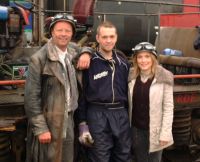 Yes, it was the Christmas 2004 “Mega Challenge” to celebrate 200 years of Trevithick and the Pen-y-Darren loco. At the time of filming Andrew was still 17 and the television company (RDF) had to get special permission from their insurers as the normal minimum age was 18. The “intro” filming included shots of “Claire” when based at Peak Rail. At one point Andrew was posed on a kiddies "ride on" engine on the platform with his Dad standing behind to obscure a grey cabinet - (Director: "You look at lot better than that box." Peter: "That's the nicest thing you've said to me all day.") The challenge was to mate a B5 bogie with an old tractor which had a seized clutch mechanism. RDF did not expect us to 'fix' the tractor's clutch and certainly had not foreseen the belt-drive arrangement we adopted ("We do NOT weld things to axles") which seemingly delighted the television producers – judging from the close-ups of pulleys running slightly eccentric! We apparently came last, and learned much later that the steam was to win no matter what (from a lecture given by Richard Gibbon at Leeds Uni) but figured that we gave the best overall entertainment, as we careered past the finish line at full tilt with the brakes having jammed off
For five years Channel 4 kept up their web-page on this edition: no sooner had we put a link to it than they changed it! Reputedly the show still pops up from time-to-time on some digital/satellite channels.
{slider title="I heard Andrew Briddon was a loco dealer. How do you square that with 'preservation'?" class="blue"} Andrew is NOT a dealer. There was an unfortunate period when one of the Industrial Railway Society "EL" (Existing Locos) books described him as such (a genuine error on the part of the IRS, subsequently corrected!) and of course, his father has been in the locomotive industry since 1978.
The decision to release some of the locos during summer 2010 will mean that the collection will be reduced, but the price Andrew sets for each loco is essentially the cost it has incurred him, without profit. In most cases it will be subject to an agreement that should the purchaser's circumstances change in the future, Andrew is given the opportunity to buy the loco back.
{slider title="Why are the locos at so many different locations?" class="blue"} In an ideal world all the locos would be at one place, but there's nowhere able to take them all. Consequently Andrew had most of them at the railways nearest to home, to minimise journey times. After searching for a suitable base to speed the restoration of the collection, negotiations with Peak Rail have resulted in the Geoffrey Briddon Building (aka 'The Shed') which we hope will serve our needs for years to come. Andrew hopes that in the future, apart from assisting Peak Rail with a small core of reliable locos, other ones in the collection will be loaned out, periodically returning for major overhaul and restoration.
{slider title="Why all these industrial's, surely ex-BR locos are more interesting?" class="blue"} The BR shunter fleet was largely a product of the 1950s modernisation plan, and in most examples was basically a "proven" industrial design with BR's specific requirements added, i.e. code light assemblies, vacuum train braking, driver's cookers, etc. The biggest exception is the Class 08-11 groups, which stem from the LMS experiments of the 1930s and were built in volume after the war because it was already proven (if not already out-of-date!). Production of 08s ceased c.1960, notably much the same time as the launch of the Sentinel (in 1959/60) which advanced industrial locomotives well away from their BR predecessors. (Sentinel locos were trialled with BR but no more shunters were being bought and no orders resulted).
Look at it this way...
| BR Class | Type | Industrial origin | |
|---|---|---|---|
| 01 | Barclay 0-4-0 DM | Standard Barclay model similar to locos built during WW2 for WD | |
| 02 | Yorkshire 0-4-0 DH | Standard YEC design butusing pneumatic clutch rather than the manual clutch offered on the industrial version | |
| 03 | BR 0-6-0 DM | Based on Class 04 | |
| 04 | Drewry 0-6-0 DM | Drewry design, similar to locos built during WW2 in 0-4-0 and 0-6-0 layouts | |
| 05 | Hunslet 0-6-0 DM | Standard Hunslet design (an earlier 0-4-0 DM version too) | |
| 06 | Barclay 0-4-0 DM | Same comments as Class 01 | |
| 07 | Ruston 0-6-0 DE | Based directly on Ruston "LSSE" class but notable change of higher cab roof (many industrial designs anticipated low bridges) | |
| 97s (a) | Ruston 0-6-0 DE | Ruston 165 DE but with manual disconnect in gearbox for towing purposes (PWM650-654) | |
| 97s (b) | NB 0-4-0 DHs | Two versions of NB 0-4-0 DH bought by BR, based on standard industrial model (D2700-D2780) | |
| 97s (c) | HC 0-6-0 DMs | Two versions of Hudswell Clarke 0-6-0DM (SSS gearbox) based on industrial offering (D2500-D2519) |
In most cases, there were more examples of the maker's industrial run-of-the-mill version built than their BR equivalent, but as enthusiasts tended to see the latter from days spent at platform ends or bunking into sheds, the locos of the industry have remained the "cinderellas" of the loco world.
So will Andrew add an 08 to the collection - very unlikely!
{slider title="Well yeah, but restoration is all about painting it, isn't it?" class="blue"} If only. While finishing the loco in a suitable colour scheme is one thing, ensuring that it is in good mechanical condition, and has the additional equipment necessary to operate on today's heritage railways is another. What is the point of having a pristine paint job if the wheels are badly worn and the engine burns as much lube oil as fuel? If we are guilty of anything, it is being more interested in the locomotives working correctly and reliably than what standard of paint finish they have, but hopefully that will improve once our own facilities enable a step-change in the standard of work we can produce.
Andrew has two "categories" of loco in the collection. Those that have historic signficance will be kept as much as reasonably possible in original condition. Those that are 'less historic' may well be altered in ways to suit them best for the work they may be called on to perform in the future. To those who say "but that's not original" we would argue that if a loco is to earn its keep then it must meet the safety and operating requirements of the railway where it is now housed. If that means fitting vacuum braking, deadmans systems or the like then so be it. Whereas we may make the minimum of external changes to the loco, we consider it perfectly acceptable to make internal changes where modern equipment, methods or sheer obsolescence makes them neccessary. 14 901 is a case in point - it had already been fitted with a Rolls-Royce engine prior to Andrew's acquisition - reversing it back to a Paxman served no purpose. Our new control system, PLC based (programmable logic controller) was our reaction to a loco with no existing electric control system where much needed to be engineered. The BMAC lights were a bit of an indulgence, but whilst we hear complaints about the "non-authentic" livery and number, these have escaped criticism, so far. {/sliders}